Riga Itinerary: 2 Days in the Latvian Capital
*Disclaimer: This blog is reader-supported, and this page might therefore contain affiliate links. When you book or buy through them, I may earn a small commission at no extra cost to you. It helps me write these in-depth and original guides, so thank you for the support! Full Affiliate Disclosure
While I’ve grown to really like Riga over my various trips, it certainly was not love at first sight. When I first visited in 2019, I couldn’t say that the city won my heart. Still, I wanted to give the Latvian capital a chance to redeem itself—and thankfully, it did precisely that. Riga is well worth visiting for anyone who loves food, history, or architecture.
-ARTICLE CONTINUES BELOW-
Free Baltic Travel Tips Delivered to Your Inbox
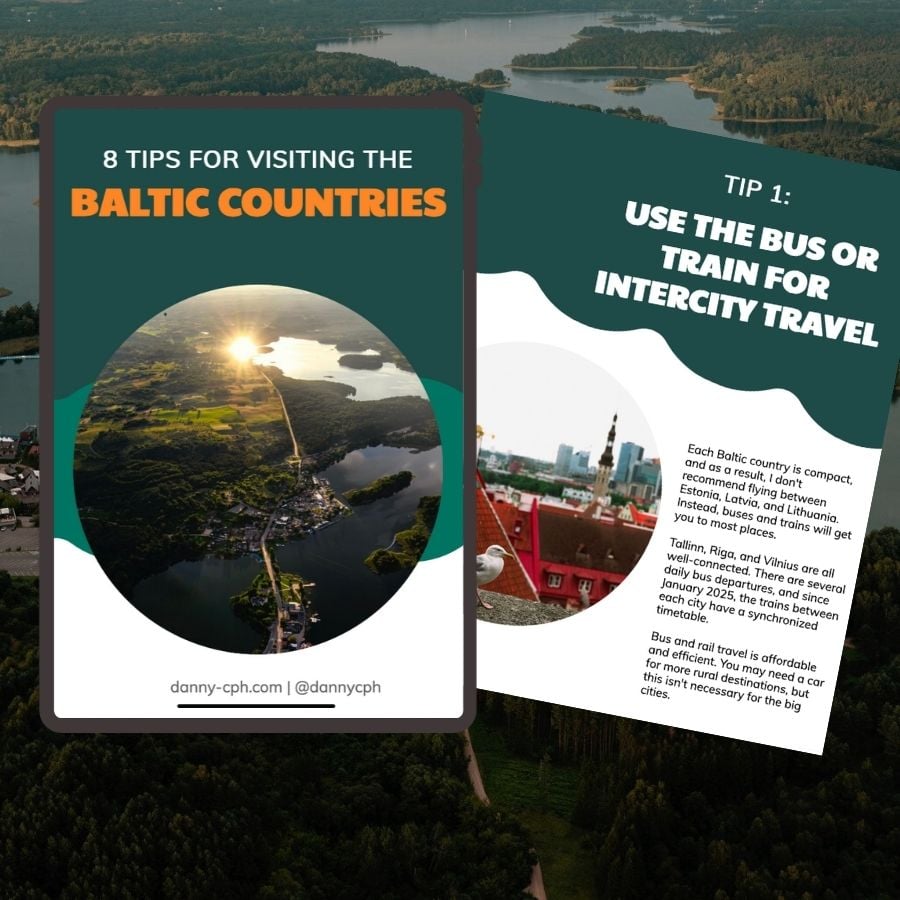
Get my FREE eBook: 8 Tips for Visiting the Baltic Countries, along with all my Baltic travel guides, delivered to your email inbox. I also send monthly newsletter updates if you sign up; unsubscribe anytime.
You may have seen the various photos of Riga’s picturesque Old Town, but those only tell one side of the story. Latvia’s biggest city is simultaneously dynamic, gritty, elegant, and hip. It’s the perfect place to spend two days, whether you’re visiting for a weekend trip or as part of a bigger adventure throughout the Baltic countries.
Based on my multiple trips to Riga, I’ve put together this easy-to-follow two-day itinerary. While you can add your own twist if you want, my aim is that you will still have an amazing trip by following what I suggest to the letter.
Day 1
Most of Riga’s main sights are within a small area, and as a result, you will spend the majority of your first day in and around the Old Town. However, we’ll also explore other parts of the city from different perspectives.
Morning
Breakfast at Big Bad Bagels
Bagels are popular throughout the Baltic region, and I’m absolutely certain that I came back with my body being 90% bread after my summer trip to Estonia, Latvia, and Lithuania. While in Riga, we went to a place called Big Bad Bagels.
The bagels here are, well, big. As for “bad”? I would say no. We were happy with having these for breakfast, and it’s a simple and convenient way to start your stay in Riga if you’ve arrived on an early flight.
Big Bad Bagels has two locations. One is in the Old Town, while the other is in another part of the Centrs District. The Old Town location is at Audēju iela 10.
Explore the Old Town
Riga’s Old Town is the main appeal for tourists visiting the city, and it’s the most logical place to start your trip. It’s one of the prettiest corners in Northern Europe, with all the “cobblestone streets and colorful houses” stereotypes well and truly met.
The main enjoyment is simply walking around and allowing yourself to get lost. Since it can get quite busy, I recommend getting to the Old Town as early as possible.


This part of Riga has a couple of highlights. My personal favorite building is the City Hall, which is on the outer edges of the Old Town.
The House of the Black Heads is worth seeing, too; while originally a warehouse dating back to the 14th century, the current iteration opened in 1999. During the Soviet era, it was demolished after being destroyed by the Nazis during the Second World War. Today, you can book tickets to see the interior.

Riga’s Old Town is scenic year-round, but it looks particularly beautiful in the winter. If you’re visiting in November or early December, you’ll find the city’s main Christmas Market here.
Visit St. Peter’s Church
I always try to find panoramic views of any city I visit, and Riga is no exception. Thankfully, the Latvian capital is blessed with a couple of these. One of the best, in my opinion, is at St. Peter’s Church.
Even before you reach the observation deck, St. Peter’s Church is worth seeing. It’s the prettiest church in Riga, with a pleasant interior. You can buy your tickets at the church itself, and unlike many towers in Europe, you can take an elevator to reach the tower’s observation deck.

Once you’re at the top, you’ll get sweeping views of Riga’s Old Town and across the Daugava River. The view of nearby Riga Cathedral is the most famous one, but it’s not the only reason to come here. You’ll also see the National Library, the Latvian Academy of Sciences building, the Freedom Monument, and more.
To enter the church, you’ll need to pay €3; entrance to the tower, meanwhile, costs €9.
Lunch: Riga Central Market
After a busy morning seeing some of Riga’s main highlights, you’ll no doubt be hungry. Riga Central Market is one of the biggest in Europe, and you will find a mixture of fresh ingredients along with places to order food and drinks.
Riga Central Market is split into a number of different halls, and I recommend walking around to see what takes your fancy. You can, of course, visit multiple places if you want to try a broader range of foods.
In addition to seeing Riga Central Market yourself, you can also join a food-tasting experience. That way, you don’t need to worry about the decision-making.
Afternoon
Riga Castle
Visiting Riga Castle was a spontaneous decision for us, but it was a nice way to spend a few hours. The original version of Riga Castle dates back to the 14th century, but the current version underwent a significant renovation project—which was completed in 2023.
The interior has some interesting exhibitions, which show both the renovation process and more about the building’s history. You’ll also get some nice views of the Old Town and across the river.
Riga Castle is on the outer edges of the Old Town. You’ll also find the Latvian National Museum of History within the building. Exhibitions are slowly being added over the coming years, so you’ll see more of an interactive experience in the future—but for now, it’s still worth seeing.

River Cruise
On one of our most recent trips to Riga, we made it a priority to join a river cruise and see the city from the Daugava. To enjoy a relaxed afternoon or evening on your trip to Riga, I recommend doing the same.
We got to learn more about Riga and its complex history in general, along with some of the landmarks we rode past. While some parts we went past weren’t so pretty, the main part of the Daugava River was scenic.

Several river cruises operate in Riga. We took this sunset cruise, but there are a number of options throughout the day, too.
Dinner at Shōyu
How often do you have dinner at a restaurant with Michelin Guide recognition, without realizing it? I would assume your answer is something like “not every day”.
That, however, is precisely what we did at Shōyu.
After taking the train from Tartu in Estonia to Riga, we went searching for some dinner around the place we were staying. Shōyu caught our attention, and the waiter offered us a table. Only then did I look up and see the Michelin Star placard.

The ramen here is good, and despite being a Michelin Star restaurant, Shōyu is pretty affordable. We had mochi for dessert, too, which—as a self-proclaimed mochi fan and expert—was delicious. If you don’t eat meat, don’t worry; Shōyu has a vegan ramen dish on its menu.
While we were lucky to get a table straight away, I would recommend booking a table in advance. You can do so on the website.
Day 2
Your second day in Riga will be a mixture of sightseeing and experiences. I’ve designed this part of the itinerary to be flexible if you have an afternoon or evening flight.
Morning
Brunch at Street Fries Kitchen
Street Fries Kitchen has large portions and a big menu at an affordable price, and it’s a good place to start your second day in the Latvian capital. To be totally honest with you, we went all-out here. The avocado toast with salmon was a highlight, as were the sweet potato fries.
You can also get coffee and other drinks here. While the food took some time to make, it was a nice way to spend a chilled morning before going out and exploring more of Riga. Street Fries Kitchen has two addresses in the city.
We personally did not have issues getting a seat here. You can find the menu on the website; besides brunch foods, you’ll also find burgers if you’d rather go closer to lunchtime.


More of the Centrs District
After having a large meal, you probably won’t want to eat for a while. So, you can spend some more time exploring the Latvian capital. Start by going to see some more of Riga’s central district outside the Old Town.
Start by going to see some of Riga’s Art Nouveau architecture. Alberta iela is the city’s most famous street for these kinds of buildings, and you will also find the Art Nouveau Museum to learn more about Riga’s history in this respect.

Afterward, you can spend some time wandering around Centrs. Stop by the Freedom Monument, the most important monument in the city. You can also go to the Galleria shopping mall to get a view of Riga from the rooftop; go to Limone for some drinks (or food if you’re feeling hungry).

Walk Along the Daugava River Promenade
Since you’ll be spending more time outside the Old Town in the afternoon, head down the promenade alongside the river. Eventually, you’ll reach some of the outermost parts of Riga’s city center. If you have some spare time, you can cross the Stone Bridge for some panoramic views across the water.
Eventually, you’ll reach the Central Market; we’ll be spending some more time around here for the rest of your trip.
Afternoon
Visit the Riga Ghetto and the Great Choral Synagogue Memorial
The Baltic region has historically been important for Jews, and Riga is one of the clearest examples of this. Before World War II, over 10% of the city’s population was Jewish—with the numbers being around 40,000.
Sadly, like much of Europe, the local Jewish population was a target for Nazi persecution. Today, the population in all of Latvia is around 4,500. While heavy, I do think it’s important to learn more about how Riga’s Jews were treated—and there are two places to do this.
The first is the Great Choral Synagogue Memorial. In 1941, the Nazis occupied Riga. During the July of that year, the Great Choral Synagogue was burnt down. You can now visit the memorial, which features rebuilt ruins. Doing so is completely free.
The Riga Ghetto was close to the synagogue, and today, it’s a large museum documenting the horrors suffered by Latvian Jews during the Holocaust. You can pay a donation to enter, and it is very informative—with multiple rooms and exhibitions.
The Latvian Academy of Sciences Building
The Latvian Academy of Sciences building was built in 1946, and it’s one of the most Soviet-style buildings you will ever see—both on the outside and in. At the top, you will find an observation deck.
From the observation deck, you’ll get views over most of Riga. You will see all the churches in the Old Town, along with Riga Central Market and some of the city center’s main bridges.

We tried visiting once and were told it was cash-only. So, we then bought our tickets online and went back the next day. I suggest doing the same, since you don’t really need cash for most places in Riga.
Practical Information for Your Riga Trip
In addition to giving you a helpful itinerary for your trip, I’ll also provide some extra useful information based on my own experiences. These tips will help you plan an even more memorable visit to Riga.
Is 2 Days in Riga *Really* Enough?
Two days in Riga is enough to see a lot of the city. If you’re doing a bigger trip through the Baltics, I personally would allocate an extra day to Vilnius. While I like Riga, Vilnius has more to offer, in my opinion.
Having said that, Riga isn’t the worst place in the world to spend a third day. If you do, you can visit the National Library or check out some more of the city’s museums and restaurants. Otherwise, you can take a day trip to Sigulda, Jurmala, or even Lithuania.
How to Reach Riga
Riga is easily reachable by plane, train, or bus.
Plane
Riga is the main hub for Air Baltic and is well-connected to much of Europe. In addition to Air Baltic, several other airlines operate flights here.
You can get direct flights to Riga from London, Copenhagen, Edinburgh, Dublin, and numerous other European cities. If you’re visiting from North America, you’re better off flying to Iceland or the UK and changing there. Otherwise, you can fly to Helsinki and then travel through the Baltics.
Once you land in Riga, I recommend taking Bolt to the city center.
Train
Riga is easy to reach by train from Vilnius and Tallinn. Trains are generally affordable, especially if you book in advance. When traveling from Estonia, we had to change in Valga for a direct train to Riga. However, everything ran smoothly.
Bus
I’ve visited Tallinn multiple times, and on one of these trips, I took the bus to Riga. It takes just over three-and-a-half hours, and buses are pretty affordable. There are several daily departures, too.
In addition to Tallinn, you can get direct buses to Riga from Vilnius (also worth visiting) and Tartu.
Paying for Things in Riga
While some places in Riga are cash-only, you often get to choose whether you want to pay with cash or card. Nowadays, I pretty much only pay by card in Riga. Every major hotel and restaurant will allow card payments, though some smaller places might prefer cash.
If you do choose to pay by card, I recommend getting an alternative to your bank card at home (unless you live in the Eurozone). For example, I normally use Wise. With Wise, I can pay in Euros—the local currency in Latvia—and waive foreign exchange fees with an EUR bank account.
You can sign up for a free Wise account here.
Summer and Winter in Riga Both Have Their Pros and Cons
Riga is a year-round city. I have visited in both the summer and winter, and the two seasons have their pros and cons.
What I really liked about the winter, for example, is that Riga looks lovely when it has been snowing. Moreover, the river looks cool when it has frozen. It’s a quiet time for tourism, too, meaning fewer crowds and cheaper hotel rates.
However, it was also very cold when I visited Riga in the winter. On top of that, it was largely gray, with short daylight hours and a rather unfriendly wind. While these aren’t deal-breakers for me, they might be for some people.
Summer, on the other hand, has long daylight hours. But at the same time, it’s often quite humid. Accommodation is also more expensive, and the city center is crowded.
Neither is better than the other, per se, but you will need to think about your preferences before booking your trip.

Getting Around Riga
While Riga does have a public transport network, I haven’t used it. The main reason is that buying tickets requires either going to a kiosk or using apps that I found needlessly hard to navigate.
To be honest, though, you don’t really need to use public transport in Riga. It’s nice that it exists, but it’s not necessary. The city is very easy to walk around, and Bolt—the main rideshare service—is reasonably priced. Traffic in Riga can be quite bad, though, so avoid Bolt during rush hour.
Useful Tip: Stay in the Centrs District
Pretty much all of the main things to do in Riga are within the Centrs district, which—as the name suggests—is the main center of Riga. As a result, you should also choose your hotel here.
Riga has a good selection of hotels and hostels for all budgets. Where you stay in the center won’t make a huge difference, but it helps to be a bit closer to the Old Town. One thing worth noting is that the main roads in Riga are quite busy, so you should keep this in mind if you’re not a deep sleeper. For example, we stayed on Elizabetes iela, and that was way too loud for me.
You can browse accommodation in Riga below.
English Proficiency in Riga
I have had zero issues communicating in English in Riga, and most people—especially in the touristy parts—will speak at least some. You should have no problems getting around in English.
Final Thoughts
Riga is worth spending a few days in, and it’s one of Northern Europe’s most intriguing cities. It’s easy to get around, and there are plenty of things to do regardless of the season. Riga also feels more authentic than many cities, which is perfect if you’re looking for a more unique experience.
Two days are enough to see the main sights in Riga and get a good baseline understanding of the city. Spending a third day will give you more flexibility to explore its surrounding areas, too. Whether you’re visiting for a weekend or going to Riga as part of a bigger Baltic adventure, keep this itinerary handy.
Pin for Later 📌


